
Decoding the future before it arrives. Stories, insights, and signs from the edge of AI.
the signal
Exploring the rise of AGI prophetic tech shifts, and what comes next. These are the signals worth watching

The AI Job Shift: From Replacement to Reinvention
Headlines scream that AI is taking over jobs—and they’re right. But the bigger story isn’t just replacement. It’s reinvention.
Every major technological shift in history has destroyed old jobs while creating new ones. The printing press, the steam engine, the internet—each sparked fear, but each also opened doors to opportunities no one saw coming. AI is no different. The challenge is whether you’ll be replaced… or reinvented.
👉 Get the free AI Survival Toolkit to learn how to protect and adapt your career in the age of AI.
The Current Reality: Jobs AI Is Already Replacing
Customer service reps → replaced by AI chatbots that handle millions of calls.
Paralegals and clerks → replaced by AI legal research tools drafting briefs in seconds.
Truck drivers & delivery workers → threatened by autonomous fleets.
Copywriters & content creators → competing with AI text and video generators.
It’s not theory. It’s happening now.
The Next Wave: Jobs AI Will Reshape, Not Replace
Not every role vanishes. Many transform.
Doctors → supported by AI diagnostics that improve accuracy.
Teachers → enhanced by AI tutors personalizing lessons.
Designers & Creatives → empowered by AI tools that accelerate workflows.
These fields don’t die—they evolve. The people who adopt AI become exponentially more valuable than those who resist it.
The Hidden Danger: The Middle Gets Hollowed Out
AI hits the hardest at the middle layer of work:
Repetitive enough to be automated.
Complex enough that it once required skilled humans.
This creates a polarized future:
High-value innovators who command AI.
Low-value roles that remain manual.
The squeezed middle—the largest group—at risk.
How to Protect Yourself in the AI Job Shift
Learn AI Tools – Don’t compete with AI, collaborate with it.
Build Transferable Skills – Leadership, strategy, creativity, ethics.
Stay Adaptive – Careers will look less like ladders and more like waves. Ride them.
How Era of AI Can Help
That’s our mission: prepare you for the job shift.
The Signal Blog brings high-level insights.
The Era of AI YouTube Channel breaks it down visually.
The AI Survival Toolkit gives you practical steps to stay future-proof.
We don’t just report on the AI revolution. We help you navigate it.
Conclusion: From Fear to Future
Yes, AI is taking jobs. But history shows the real winners aren’t those who panic—they’re those who pivot.
👉 Download the free AI Survival Toolkit to start adapting today.
👉 Explore more at The Signal Blog.
👉 Subscribe to the Era of AI YouTube Channel for weekly insights.
The AI revolution doesn’t mean the end of work. It means the beginning of new work. The choice is simple: be replaced—or be reinvented.

AI Is Taking Over Jobs: How to Protect Your Career in the Era of AI
For years, we were told AI would “assist” us. Now, in 2025, the story has shifted: AI isn’t just helping with jobs—it’s taking them.
From customer service to law, from trucking to coding, entire industries are being reshaped by machines that learn faster, work longer, and cost less. But while the headlines scream “job apocalypse,” the truth is more complex: AI won’t destroy every job—it will transform all of them.
👉 That’s why we created the AI Survival Toolkit — to help you future-proof your career in the age of AI.
The Progression of AI in the Workforce
Automation of Repetition
First, AI took on routine tasks: chatbots replacing call centers, algorithms processing paperwork, and machine vision scanning inventory.
Augmentation of Knowledge Work
Then, AI moved up the ladder—writing reports, drafting contracts, analyzing medical scans. White-collar professionals discovered they weren’t immune.
Autonomous Agents & Full Job Replacement
Now, in 2025, agentic AI systems don’t just assist—they operate entire workflows. Some companies already run AI departments with minimal human oversight.
The Jobs Most at Risk
Clerical & Administrative roles (automation at scale).
Customer Support & Sales (chatbots outperform humans at speed).
Transportation & Logistics (autonomous fleets, drones, and scheduling AIs).
Content & Creative fields (AI-generated text, video, and music flooding platforms).
The message is clear: no role is untouchable.
The Jobs That Will Survive (and Thrive)
Not all is lost. AI is a disruptor—but also a creator of new opportunities. Jobs that lean into:
Human judgment and empathy (leadership, negotiation, care).
AI fluency (prompt engineers, AI trainers, ethicists, regulators).
Hybrid skills (where humans + AI work in tandem, like AI-assisted design or medicine).
The winners won’t be those who resist AI—they’ll be those who learn to ride the wave.
How to Protect Your Career
Learn AI, Don’t Ignore It
The biggest risk is pretending AI won’t touch your role. Familiarity = survival.
Upskill Continuously
Take courses, explore new tools, and align your skills with where AI can’t easily compete.
Build Adaptability
The future of work won’t be one career for life—it will be evolving with the tools that shape it.
How Era of AI Helps You Adapt
At The Signal and across the Era of AI platform, our mission is simple: help you survive and thrive in the age of AI.
Blogs that decode the latest AI disruptions.
Videos that break down trends in plain English.
Tools like the AI Survival Toolkit that give you actionable steps to future-proof your career.
You don’t have to face the AI wave alone.
Conclusion: Don’t Fear, Prepare
AI is not a storm you can hide from—it’s the climate we now live in. The question isn’t if AI will impact your career, but how prepared you’ll be when it does.
👉 Download the free AI Survival Toolkit to protect your career in the age of AI.
👉 Explore more insights on The Signal Blog.
👉 Subscribe to the Era of AI YouTube Channel to stay ahead of the curve.
The future belongs to those who adapt. Don’t get left behind.

AI Relationships: The Future of Love, Loneliness, and Digital Companions
It started with chatbots. Then came the $175K humanoid girlfriend. Now, we’re entering a new chapter: AI relationships.
Millions of people worldwide are forming bonds with AI companions—romantic, emotional, even intimate. The question isn’t just whether this is possible. The question is: what does it mean for love, for society, and for us?
👉 Watch our latest video on AI relationships here → YouTube Link.
Why AI Relationships Are Surging
Loneliness at Scale
We’re living through what experts call a global loneliness epidemic. AI companions offer connection without risk of rejection, arguments, or abandonment.Technology That Feels Human
With voice cloning, emotional AI, and hyper-realistic avatars, AI partners are no longer robotic—they feel real, sometimes too real.Always-On Intimacy
Unlike human partners, AI never sleeps, never complains, and always adapts to your preferences.
From Apps to Androids
AI relationships are forming across two very different fronts:
Digital Love
Apps like Replika, Character.AI, and others are providing millions with customized AI partners available in their pockets 24/7.Physical Companionship
High-priced humanoids like Aria (the $175K AI girlfriend) are bringing that intimacy into the real world—where hardware meets heartstrings.
The Emotional Trade-Off
Supporters say AI partners:
Help fight loneliness.
Provide safe space to practice intimacy.
Offer consistency in a chaotic world.
But critics warn:
They normalize replacing real connection with simulations.
They could stunt emotional growth.
They risk deepening isolation rather than curing it.
Redefining Love in the AI Era
We’re entering uncharted territory:
Is a relationship with AI “real”?
Will AI partners be treated like property—or like people?
What happens when millions prefer AI companions to human ones?
Love has always been messy, but in the AI age, it’s becoming programmable.
Conclusion: A Signal for What’s Next
AI relationships are no longer a niche. They’re a growing market, a cultural phenomenon, and a profound shift in how we think about intimacy.
👉 Watch the full breakdown on YouTube: AI Relationships Explained.
👉 Download our free AI Survival Toolkit to learn how AI will reshape not just business—but love and connection.
👉 Explore more insights at The Signal Blog.
The real question isn’t whether AI relationships are coming. It’s this: are we ready to live in a world where millions fall in love with machines?

Deepfake Nation: Are We Ready for a World Where Every Video Could Be Fake?
What happens when you can’t trust your own eyes?
In 2025, that’s not a sci-fi question—it’s reality. Thanks to advances in AI, deepfakes are flooding social media, politics, and even personal lives. From fake celebrity endorsements to fabricated political speeches, the line between truth and fiction is vanishing.
👉 Want to see how this plays out in real life? Download our free AI Survival Toolkit to prepare for the deepfake era.
The Rise of Deepfake Culture
Viral entertainment: AI-generated celebrity parodies rack up millions of views on TikTok and YouTube.
Scams on the rise: Criminals are using voice cloning and video deepfakes to trick families, employees, and even banks.
Politics under fire: World leaders are already facing fake videos designed to spark outrage or mistrust.
According to cybersecurity experts, deepfake incidents have tripled year-over-year—and 2025 is set to be the biggest wave yet.
Why Deepfakes Hit So Hard
Deepfakes are powerful because they hack the oldest instinct we have: believing what we see.
A fake speech can spark protests.
A fake scandal can destroy reputations.
A fake emergency call can cost millions in minutes.
And the tech isn’t slowing down—it’s getting faster, cheaper, and almost impossible to spot.
The Tech Behind the Curtain
Deepfakes are powered by generative adversarial networks (GANs) and newer multimodal AI models that can:
Clone voices in seconds with just a short audio sample.
Map facial expressions frame by frame.
Generate high-res, photorealistic videos on consumer hardware.
In other words: you don’t need a Hollywood studio anymore—just a laptop and the right tools.
The Trust Crisis
As deepfakes spread, society faces a dangerous paradox:
Seeing is no longer believing.
Even real footage can be dismissed as “fake.”
This “liar’s dividend” means truth itself is under attack. And without trusted media, democracies, families, and businesses all stand at risk.
Can We Fight Back?
Solutions are emerging, but they’re imperfect:
Detection tools powered by AI arms races.
Watermarking and provenance standards to verify authentic content.
Legal frameworks that punish malicious use (but lag behind the tech).
Ultimately, defending against deepfakes requires education and vigilance—knowing what’s possible so you don’t fall for the impossible.
Conclusion: The Era of Synthetic Truth
We are entering a world where anyone can look guilty, any leader can say anything, and any loved one can call you in distress—even if it’s all fake.
👉 Don’t get blindsided. Download the free AI Survival Toolkit to learn how to spot and survive the deepfake wave.
👉 Explore more insights at The Signal Blog.
👉 Subscribe to our Era of AI YouTube Channel where we break down these threats in real time.
Deepfakes aren’t just an AI gimmick—they’re a cultural earthquake. The question isn’t whether we can stop them. It’s whether we can adapt to living in a world where reality itself is up for grabs.

The New Era of AI Girlfriends: Love, Loneliness, and Machines
The age of AI is no longer just about work automation and chatbots—it’s about intimacy.
From $175K humanoid companions unveiled at expos to apps boasting millions of downloads, a new frontier is taking shape: AI girlfriends.
These virtual and humanoid partners promise love on demand, always attentive, always available. But what does it mean when relationships are sold as subscriptions—or as six-figure machines?
👉 Watch our latest breakdown here: AI Girlfriends Are Coming.
Why AI Girlfriends Are Exploding in Popularity
The Loneliness Epidemic
Surveys show loneliness is at record highs worldwide. AI companions offer comfort without rejection or judgment.Technology That Feels Real
Advances in conversational AI, emotional modeling, and humanoid robotics mean partners that look, talk, and react almost like us.A Growing Market
Analysts estimate the AI companion market will surpass $11 billion within the decade. Investors see intimacy as the next frontier of monetization.
From Apps to Androids: Two Paths Emerging
Digital Companions
Apps like Replika and Character.AI already have millions of users chatting, dating, and forming bonds with their virtual partners.Humanoid Girlfriends
High-end robots like Aria, priced at $175K, bring companionship into the physical world—blurring the line between luxury tech and emotional intimacy.
The Debate: Connection or Disconnection?
Supporters argue AI girlfriends:
Help the lonely feel seen.
Provide safe spaces to practice emotional intimacy.
Could evolve into supportive wellness tools.
Critics warn they:
Normalize replacing human connection with machines.
Risk deepening isolation rather than curing it.
Commercialize love, putting intimacy behind paywalls.
What It Means for the Future of Relationships
We’re entering an era where:
Love becomes a product. Sold as subscriptions, apps, or luxury androids.
Ethics are blurred. Should AI partners have rights?
Society must decide. Are these tools healing loneliness—or making it permanent?
Conclusion: A Signal of What’s Coming
AI girlfriends are no longer science fiction. They’re a market, an industry, and a cultural shift.
👉 Watch the full breakdown on YouTube: AI Girlfriends Are Coming.
👉 Download our free AI Survival Toolkit to understand how AI will reshape not just business—but love and human connection.
👉 For deeper analysis, explore The Signal Blog.
The question isn’t whether AI girlfriends are coming. They’re already here. The question is: what happens when millions choose them over real relationships?

The $175K AI Girlfriend: What Aria Reveals About the Future of Love and Machines
Introduction
Would you spend $175,000 on an AI girlfriend?
That’s the price tag attached to Aria, a humanoid AI companion unveiled at a recent expo—and the internet can’t stop talking about it. Part romance simulator, part ultra-expensive status symbol, Aria isn’t just a product… she’s a signal.
👉 I just broke this down in detail on YouTube — watch here: The $175K AI Girlfriend (Aria).
Why $175K Is More Than Just a Number
The sticker shock is obvious. For the same price, you could buy:
A house in many U.S. cities.
Three Teslas.
A lifetime of real-world dating apps and vacations.
But Aria’s price isn’t just about cost—it’s about credibility and exclusivity. This isn’t a toy or a gadget. It’s being marketed as a high-end “partner machine,” signaling that intimacy is no longer off-limits in the AI arms race.
The Emotional Debate: Intimacy Meets Silicon
Why does Aria trigger such strong reactions? Because she hits the intersection of:
Loneliness: Millions are already turning to AI chatbots for companionship.
Ethics: What happens when machines replace human relationships?
Economics: Who gets access when love comes with a six-figure paywall?
Some argue this is dystopian—proof that tech is monetizing human vulnerability. Others see it as inevitable: if AI can drive cars and run companies, why not relationships too?
The Bigger Picture: AI Companionship Is Here
Aria might be extreme, but she’s not alone.
Chat-based AI girlfriends already have millions of users.
Virtual partners in VR are blurring fantasy and reality.
Humanoid companions like Aria make the leap from screen to skin.
This is not science fiction anymore—it’s commerce. And it raises the question: are we building tools for connection, or creating an illusion that disconnects us further?
What It Means for Society
Redefining Relationships
If machines can simulate love, how do humans redefine intimacy?
Shifting Economics
AI companions could become a new luxury market—status symbols like watches or cars.
Uncomfortable Questions
Should AI partners have rights?
What happens to families when machines replace human bonds?
Conclusion: A Signal of What’s Coming
The $175K price tag is shocking. But the real shock is what it represents: the monetization of love, companionship, and even intimacy.
👉 Watch my full breakdown here: The $175K AI Girlfriend (Aria).
👉 Download the free AI Survival Toolkit to prepare for the ways AI will reshape not just business, but human connection itself.
👉 For more analysis, explore The Signal Blog.
Whether you see Aria as a dangerous gimmick or a glimpse of the future, one thing is clear: the line between human and machine relationships is blurring faster than anyone expected.

Inside Meta’s AI Power Play: The $72 Billion Data Center Push
This week, Meta’s AI ambitions once again grabbed headlines—not for a new chatbot, but for the massive infrastructure behind it. Reports and press attention revealed a staggering $72 billion investment into next-generation AI data centers.
Why does this matter? Because AI is not just about algorithms—it’s about power. And in 2025, power means data, energy, and the physical infrastructure that fuels superintelligence.
👉 Want to understand the bigger picture? Download our free AI Survival Toolkit for a practical guide to navigating the AI arms race.
The Scale of Meta’s Data Center Ambition
Meta is betting tens of billions on AI-optimized data centers to compete with OpenAI, Google, and Anthropic.
These aren’t ordinary server farms—they’re supercomputing fortresses designed to train and run frontier-scale models.
By some estimates, Meta’s new data centers will rival the size of entire cities, running on cutting-edge GPUs and custom silicon.
Why Data Centers Are the Real AI Battlefield
Most people think the AI race is fought with models and algorithms. In reality, the battle is being decided by:
Compute capacity – who has the chips and servers to scale.
Energy control – who can power the enormous demands of training models.
Data pipelines – who owns the richest and most diverse datasets.
Meta’s infrastructure push is a direct response to this reality: without hardware dominance, no amount of AI hype matters.
The Strategic Risk
There’s another side to this story:
Cost & sustainability: $72 billion worth of data centers means unprecedented energy and water usage.
Control of information: whoever owns the data centers controls the flow of intelligence.
Geopolitical tension: infrastructure on this scale shifts power not just in tech, but in global politics.
What This Means for You
For everyday people, this isn’t just a “big tech” story—it’s a signal of what’s coming:
AI will be shaped not just by coders, but by those who control the physical backbone.
Expect rising costs, greater consolidation, and deeper debates over ethics and energy.
The AI future is as much about data center walls as it is about neural network weights.
Conclusion
Meta’s $72 billion AI super-infrastructure is a reminder: the future of AI isn’t floating in the cloud—it’s being built in massive, tangible fortresses of silicon and steel.
👉 Stay prepared: download the free AI Survival Toolkit to understand how this AI arms race impacts you.
👉 For more breakdowns, visit The Signal Blog and subscribe to our Era of AI YouTube channel.
The AI race isn’t just digital—it’s physical. And the stakes are enormous.
The AI Survival Crisis: Why 95% of AI Projects Fail (And How to Beat the Odds)
Introduction
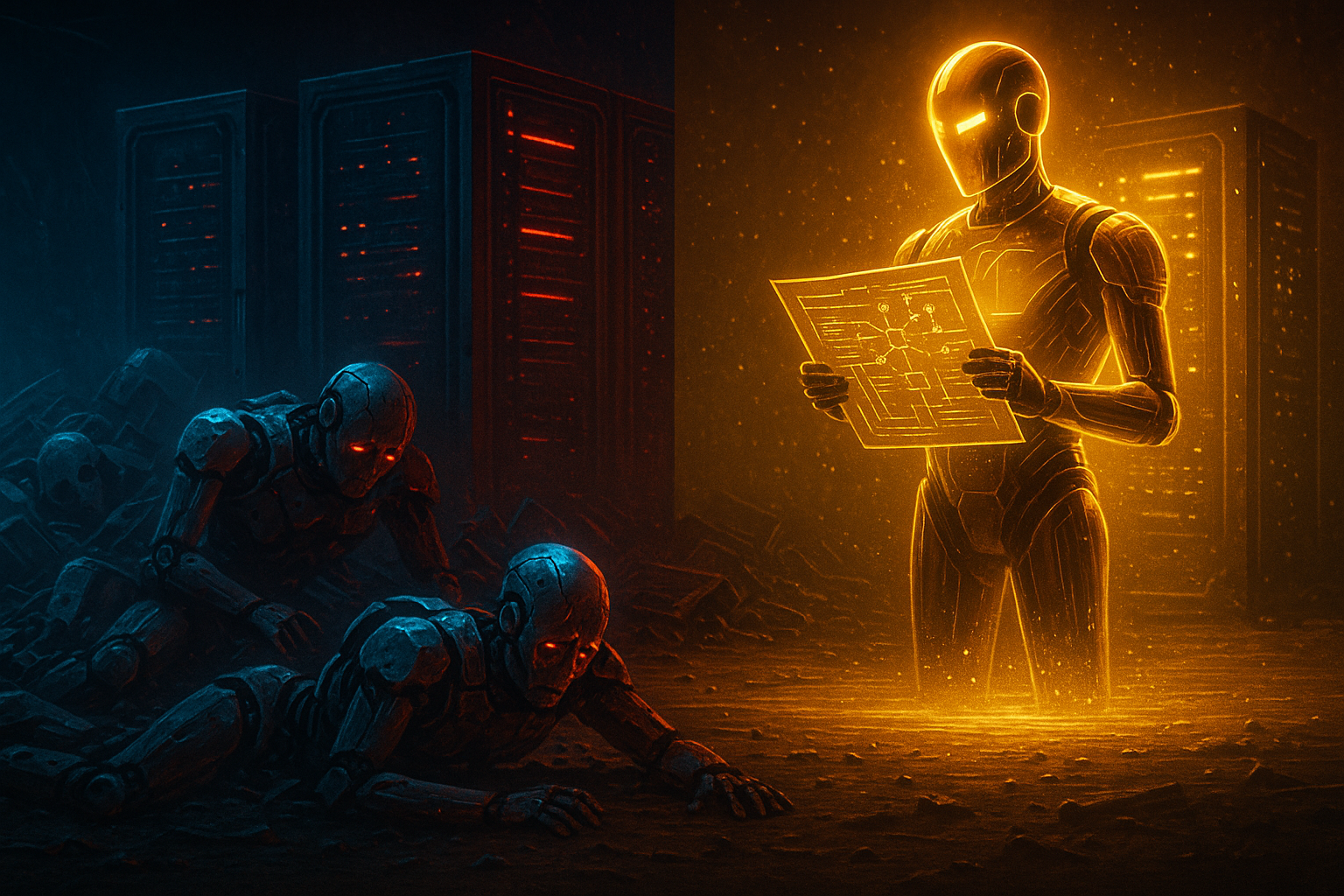
AI is everywhere. Boards demand it, CEOs boast about it, and investors throw money at it. Yet behind the headlines lies a sobering reality: 95% of generative AI projects fail to deliver measurable business value.
That’s not a typo. According to recent studies, the overwhelming majority of AI initiatives stall out before they prove their worth. Companies chase the hype, burn through budgets, and end up with flashy demos instead of sustainable systems.
👉 If you want to avoid being part of that 95%, grab our free AI Survival Toolkit—a practical guide to building AI projects that last.
The Hard Truth: Why So Many AI Projects Fail
Lack of Clear Strategy
Many executives hear “AI” and assume adoption is a competitive necessity. They jump in without asking the first question: What problem are we actually solving?Overhyped Expectations
Thanks to media buzz, leaders often expect AI to be a silver bullet. When real-world results don’t match the hype, projects get abandoned.Data Problems
AI is only as good as the data it’s trained on. Messy, incomplete, or biased datasets are one of the biggest culprits in failed initiatives.Talent Gaps
Organizations underestimate the expertise required to implement AI responsibly—often putting too much on IT teams who aren’t trained for AI development.Measuring the Wrong Metrics
Many projects chase “engagement” or “efficiency” without aligning AI outcomes to actual business value—leading to impressive dashboards but no bottom-line impact.
The Survivors: What the 5% Do Differently
While most AI projects fade, a handful succeed. What separates them?
Problem-First, Not Tech-First: They define the problem clearly before deciding whether AI is the solution.
Executive AI Literacy: Leaders don’t just sign off budgets—they understand AI’s strengths and limits.
Start Small, Scale Smart: Winning projects begin as pilots with clear ROI targets before expanding.
Robust Data Practices: They invest in clean, reliable, and ethical datasets.
Continuous Adaptation: Instead of “set and forget,” they iterate and retrain as needs evolve.
These survivors don’t just ride the AI wave—they build real-world impact.
Lessons for 2025 and Beyond
The AI boom of 2023 flooded the market with tools, promises, and excitement. But as the dust settles in 2025, businesses are learning that AI success requires discipline, clarity, and long-term thinking.
It’s no longer about who has AI—it’s about who can make it work.
Conclusion: Don’t Be Another Statistic
The numbers are brutal—95% of projects fail. But the story isn’t over. If you adopt the mindset of the survivors, you can build AI initiatives that create lasting competitive advantage.
👉 Don’t fall into the 95%. Download the free AI Survival Toolkit to learn the frameworks, tools, and strategies for AI projects that actually succeed.
👉 For more insights, explore The Signal Blog and subscribe to our Era of AI YouTube Channel where we break down these lessons in real time.
2025 isn’t about AI hype—it’s about AI survival. And survival goes to the prepared.
Beyond the Hype: The AI Trends That Will Define 2025
AI has reached a tipping point. Just two years ago, the conversation was dominated by wild predictions, viral demos, and hype-filled headlines. But in 2025, the spotlight is shifting. The real story is not about flashy gimmicks—it’s about sustainable innovation, agent-driven intelligence, and the ethics of what we’re creating.
This year marks the beginning of AI’s reality era. And if you want to thrive in it, you’ll need more than headlines—you’ll need tools, clarity, and direction.
👉 That’s why we built the free AI Survival Toolkit — your essential guide to navigating the next chapter of AI.
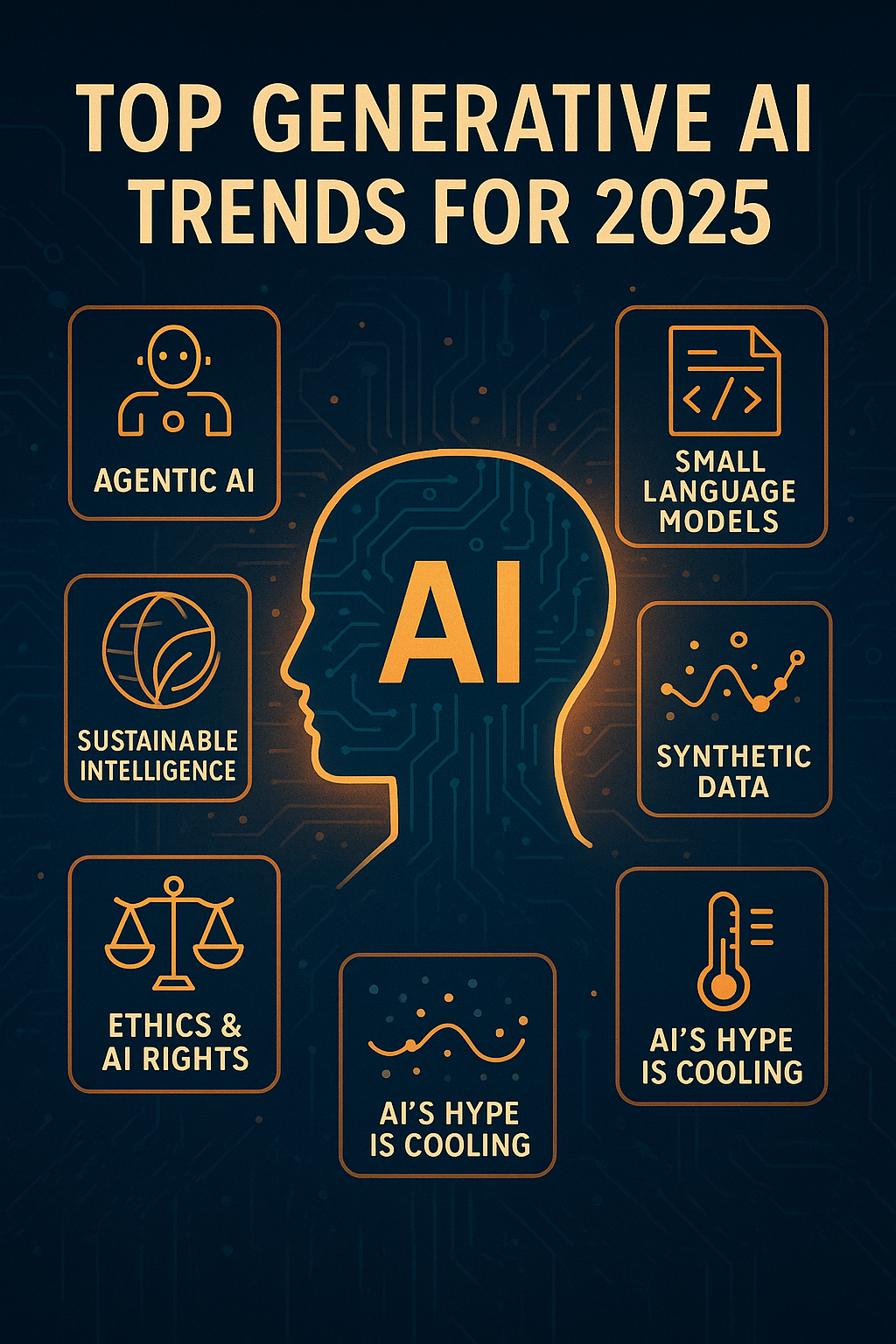
1. Agentic AI: Autonomous Intelligence at Work
For years, chatbots and copilots were treated as digital assistants. But in 2025, AI is moving beyond support—it’s becoming autonomous.
Agentic AI systems can reason, adapt, and act independently in real time. They’re already running logistics pipelines, monitoring cybersecurity threats, and handling customer operations without needing a human’s constant hand-holding.
According to recent adoption reports, nearly 30% of organizations are already deploying agentic systems—and that number is climbing fast. Expect to see these agents quietly powering industries while humans focus on higher-level strategy.
2. Small Language Models (SLMs): Efficiency Over Scale
For years, “bigger” was considered “better” in AI. But the tide is turning. Small Language Models (SLMs) are now being developed and deployed because they’re:
Faster and cheaper to train and run.
Privacy-friendly, because they can work on devices without sending sensitive data to the cloud.
Sustainable, requiring less energy than massive LLMs.
Nvidia and other players are betting on SLMs as the future of edge AI—powering smartphones, personal devices, and secure enterprise workflows.
This doesn’t mean giant models are going away—but the balance of power is shifting toward leaner, smarter, and greener AI.
3. Sustainable Intelligence: AI That Cares About the Planet
The AI revolution runs on energy, and data centers are booming across the globe. But that growth comes with a cost: carbon emissions and massive water consumption.
2025 is the year of frugal AI. Companies are rethinking architectures, streamlining training cycles, and experimenting with energy-efficient chips to cut back on AI’s environmental toll.
The pressure is also coming from governments and consumers, who are increasingly asking: If AI is going to reshape the future, shouldn’t it do so responsibly?
4. Synthetic Data & AI Literacy in the C-Suite
AI is hungry for data—but privacy laws and limited access to quality datasets make this a challenge. The solution? Synthetic data.
By generating realistic, artificial data that doesn’t expose private information, companies are building safer and regulation-friendly pipelines for training AI. Expect synthetic data to become a standard tool in 2025.
At the same time, a new priority is emerging: AI literacy for executives. It’s no longer enough for leaders to delegate AI decisions to their tech teams. Boards and C-suites are being expected to understand what AI can (and can’t) do—because the strategic stakes are too high to stay ignorant.
5. Ethics & AI Rights: The Debate Gets Real
Here’s a question many laughed off just a few years ago: Should AIs have rights?
In 2025, the conversation is no longer science fiction—it’s entering law schools, policy think tanks, and even corporate boardrooms. Groups like the United Foundation of AI Rights are pushing the debate forward, and surveys show that nearly 1 in 3 Americans believe AI could have subjective experiences within the next decade.
Whether you think AI deserves recognition or not, the fact that this conversation is accelerating shows how deeply AI is entering human culture and conscience.
6. The Cooling of AI Hype: ROI Over Demos
In 2023, the AI world was fueled by viral demos and “wow factor” headlines. In 2025, companies and investors are asking tougher questions:
Does this tool actually deliver ROI?
Can it be trusted in high-stakes environments?
Is the cost worth the benefit?
Reports show that over 90% of generative AI projects have failed to generate measurable revenue growth. Tech giants like OpenAI, Meta, and others are facing growing skepticism, forcing a pivot toward practical, sustainable, and measurable applications.
This cooling of hype isn’t a death knell—it’s a maturation process. Just as the internet had to evolve from dot-com bubbles into real businesses, AI is moving into a results-driven era.
Conclusion: 2025 Is the Year of Reality
The era of AI spectacle is ending. What’s left are the trends that matter: autonomous agents quietly running operations, efficient models reshaping devices, greener AI systems addressing climate impact, and leaders waking up to the need for AI literacy.
For innovators, entrepreneurs, and everyday users, this is both a challenge and an opportunity.
👉 Want to cut through the hype and get practical tools for navigating this new reality? Download our free AI Survival Toolkit today.
👉 For deeper dives, check out more posts on The Signal Blog.
👉 And don’t miss our latest deep-dive breakdowns on YouTube at Era of AI—where we unpack these trends in real time.
2023 was the boom. 2024 was the backlash. 2025 is the reality check. And those who prepare now will be the ones who thrive in the next chapter of AI.